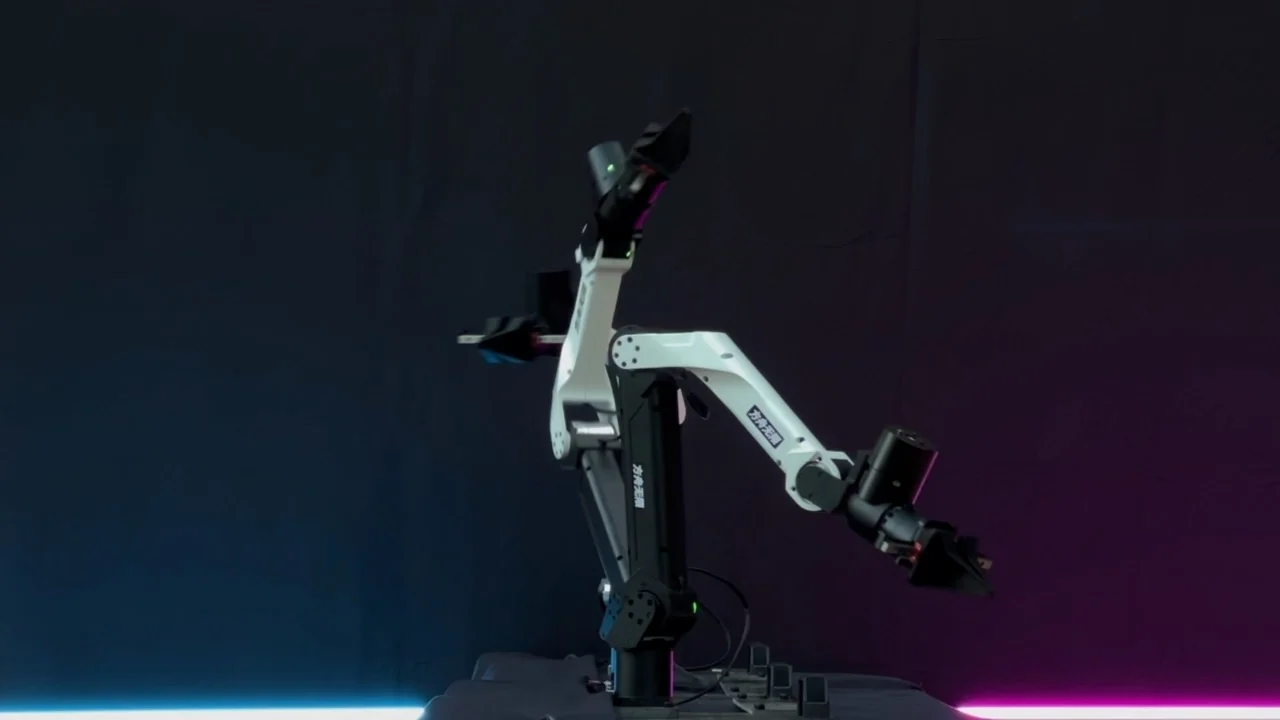
Why force control matters for imitation learning
Short answer: a force-controlled arm commands and senses torque at its joints, not only position. For imitation learning that means three things: the arm can be guided by hand in gravity compensation, it complies instead of fighting when it touches something, and it can serve as both leader and follower in teleoperation. Quasi-direct-drive (QDD) motors make this practical in a light arm.
Position control and force control
A position-controlled arm is told where each joint should be and pushes until it gets there. That is precise in free space, but on contact the arm keeps pushing until something gives.
A force-controlled arm is told how much torque to apply, or how stiff to be around a target. With low stiffness it yields on contact. With gravity compensation it holds its own weight, so a person can move it by hand and it stays where it is left.
Most research arms mix the two: a position target with tunable stiffness and damping. The ARX A5 SDK exposes this directly as MIT mode, which sets stiffness (kp), damping (kd), target position, target velocity and feed-forward torque per joint.
What quasi-direct drive changes
QDD motors use a low gear ratio. Two things follow:
- The arm is back-drivable. A person can push the joints by hand without fighting a high-ratio gearbox, which is what leader arms and teach-and-replay need.
- Motor current tracks joint torque closely. The controller can read torque from current, so the arm can feel contact without a separate force sensor at every joint.
The trade-off is that a QDD research arm is not an industrial cobot. It is built for light payloads and learning research, not for heavy, high-precision production work. The X5, for example, is rated for 2 kg with a 3 kg peak.
Where it shows up in data collection
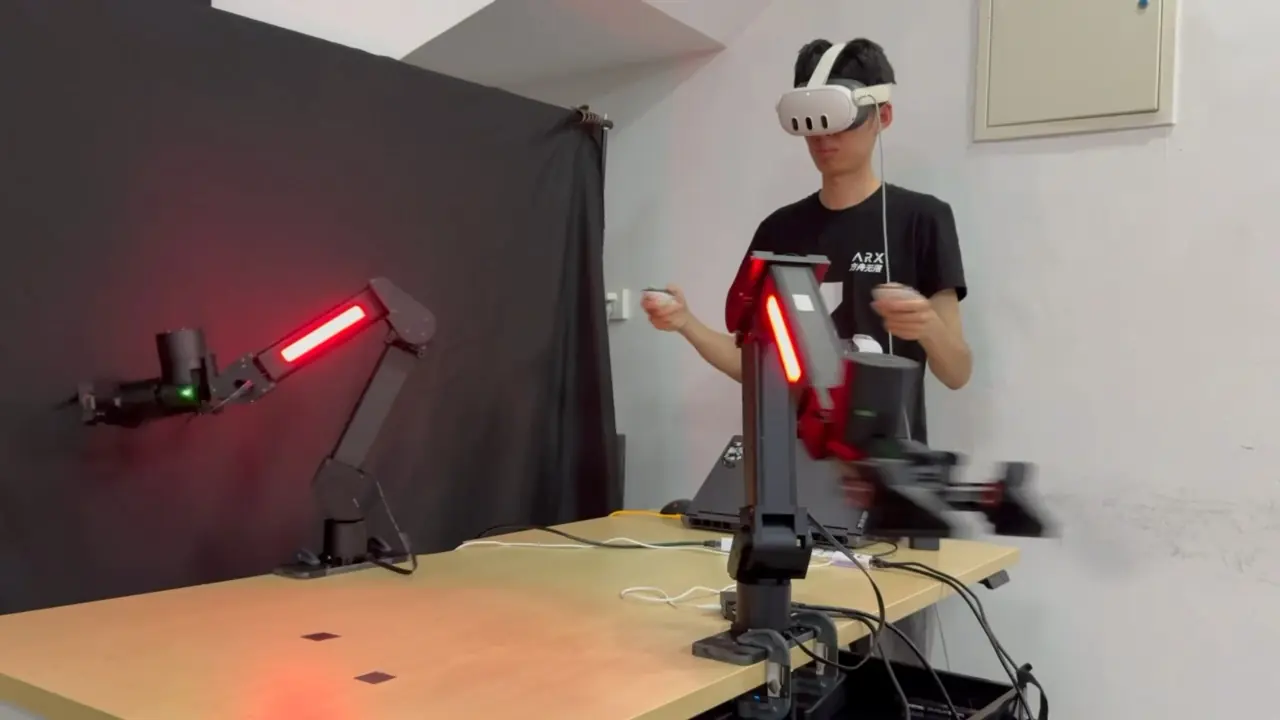
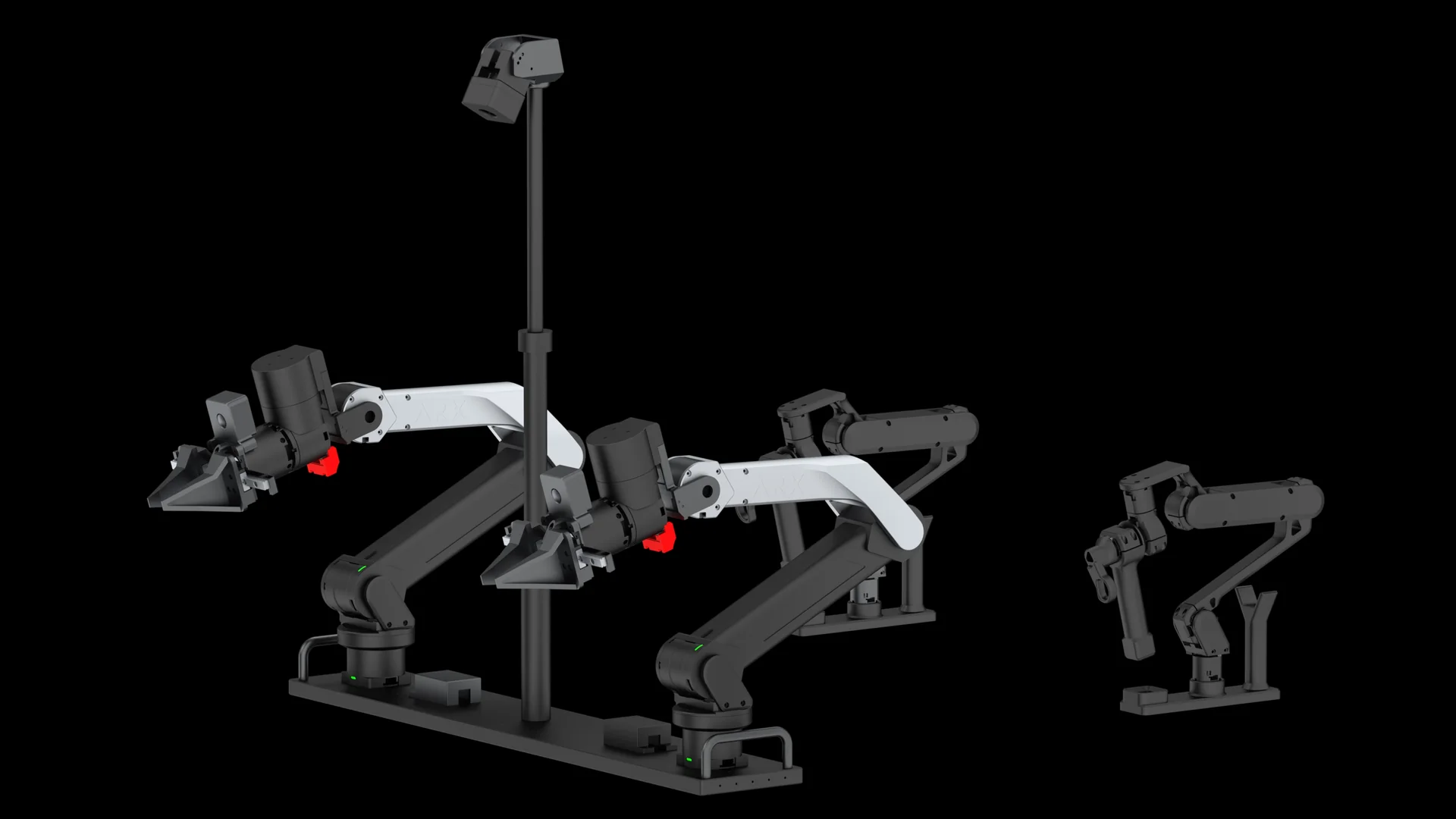
- Teleoperation feels right. Leader arms in gravity compensation are light in the hand, so operators record smoother demonstrations.
- Contact is safer. Followers that comply on contact are less likely to damage objects, fixtures or themselves when a demonstration goes wrong.
- Teach and replay is easy. Stanford's arx5-sdk includes a teach-and-replay example for X5: guide the arm, record, play back.
- Policies get another signal. Joint current or torque can be logged with images and positions, which helps on contact-rich tasks such as wiping or insertion.
Features to check before you buy
| Feature | Why it matters | ARX examples |
|---|---|---|
| Torque or current feedback per joint | Contact sensing, safer policies | X5 senses torque at every joint; the X5 and A5 SDKs report joint current |
| Gravity compensation | Hand guiding, light leader arms | gravity_compensation() in the X5 and A5 SDKs |
| Adjustable end mass | Keeps compensation correct after adding a camera | X5 and A5 SDKs let you change the link-6 mass |
| Torque-level command | Your own impedance or force controllers | A5 MIT mode |
| Control loop rate | Smooth tracking during teleoperation | 500 Hz joint loop in arx5-sdk |
| Open SDK, no ROS required | Fits any training stack | arx5-sdk in Python and C++ |
A practical note from ARX's X5 guide: gravity compensation assumes the default gripper. If you add a wrist camera and the arm drifts down, raise the configured end mass; if it drifts up, lower it.